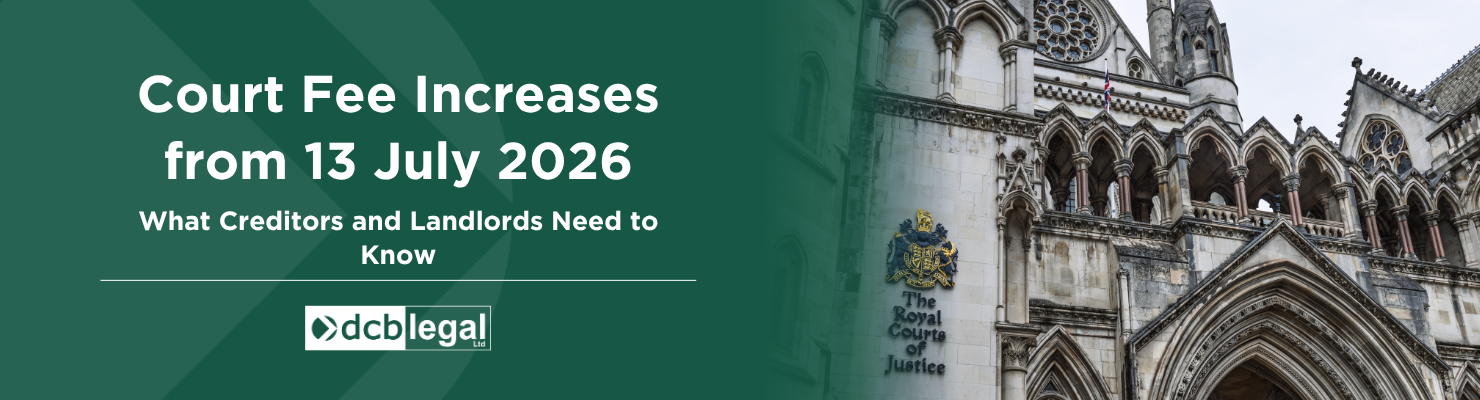
The Ministry of Justice has announced an updated schedule of court and tribunal fees coming into effect on 13 July 2026. Adjusted to reflect inflation and the ongoing administrative costs of the justice system, these increases will impact anyone relying on the civil courts to recover debts or regain possession of a property.
Crucially, the increases are not retrospective. They apply only to claims and applications issued on or after the deadline date, which leaves a short window to issue proceedings under the current, lower fees. If you have matters ready to issue on, Contacting DCB Legal before this date could avoid the increases.
When litigation becomes more expensive, strategy becomes more important. Here is a breakdown of the new fees and what they mean for your legal strategy moving forward.
The New Fee Schedule at a Glance
Whether you are issuing a claim, making an interim application, or enforcing a judgment, upfront costs are rising across the board.
| Court Process | New Proposed Fee |
|---|---|
| Possession Claim | £415 |
| Application on Notice | £321 |
| Without Notice Application | £126 |
| County Court Bailiff | £152 |
| Third Party Debt Order (TPDO) | £139 |
| Charging Order | £139 |
| Attachment of Earnings | £139 |
| Order to Attend Court for Questioning | £69 |
How This Affects Property Litigation Clients
For landlords and property managers, the cost of dealing with problem tenants is getting steeper.
The standard fee for a Possession Claim is rising to £415. If the tenant refuses to leave after a possession order is granted, applying for a County Court Bailiff (a warrant of possession) to physically execute the eviction will now cost an additional £152 – a route that is often plagued by heavy court backlogs and long waiting times.
What this means for you:
Efficiency is critical, both in litigation and enforcement. First, there is no longer any room for administrative errors. If a Section 8 notice is drafted incorrectly, a judge may strike out your claim, forcing you to pay that £415 fee a second time.
Moreover, you can bypass the County Court Bailiff delays entirely. We work in tandem with our High Court enforcement partner, DCBL. By transferring the possession order up to a High Court Writ, DCBL can enforce the eviction significantly quicker and more effectively, minimising your rental losses.
How This Affects Money Claim Clients
For businesses and individuals recovering unpaid debts, obtaining a County Court Judgment (CCJ) is only half the battle. The most significant fee hikes impact the enforcement tools used to recover the money owed. Whilst the court fee increases impact High Court Enforcement costs, rising from £80 to £82, this is nominal in comparison to the cost of other enforcement methods when High Court Enforcement is not an option.
Additional enforcement methods – such as a Charging Order (securing the debt against a debtor’s property), a Third Party Debt Order (freezing money in the debtor’s bank account), and an Attachment of Earnings (taking money directly from the debtor’s wages) – will all increase to £139. Even forcing a debtor to reveal their financial situation via an Order to Attend Court for Questioning will now cost £69. Furthermore, if you need to make an Application on Notice during the proceedings, you will be facing a hefty £321 fee.
What this means for you:
The risk of “throwing good money after bad” is higher than ever. Creditors can no longer afford a scattergun approach to enforcement. Before paying a £139 fee for an Attachment of Earnings or a TPDO, you need rigorous pre-enforcement investigation to ensure the debtor actually has the means to pay.
Why Use DCB Legal?
At DCB Legal, we understand that every pound spent on court fees is further sunk costs into recovering a balance or estate. As specialists in debt recovery and property litigation, our focus is on maximising your recovery while minimising unnecessary court spend.
Here is how we protect our clients from the impact of these fee increases:
- Getting it right the first time: Our property litigation experts ensure that every notice, claim form, and witness statement is robust, significantly reducing the risk of claims being struck out on technicalities.
- Faster, stronger enforcement: Through our seamless partnership with DCBL, we can escalate your enforcement to the High Court, bypassing County Court bottlenecks to recover your property or funds swiftly.
- Strategic intelligence: We don’t just blindly apply for alternative enforcement orders. We use extensive pre-litigation and pre-enforcement intelligence to assess the debtor’s assets, recommending only the enforcement routes most likely to succeed.
- Alternative Dispute Resolution (ADR): Where possible, our robust pre-action protocols and negotiation tactics often secure payment or property possession before court fees ever need to be paid.
The cost of litigation is rising, but with the right legal partner, your success rate can rise with it. Contact DCB Legal today to discuss how we can streamline your debt recovery and property litigation strategies.